Google Review Response Templates That Do Not Sound Canned
StarReplies Team · July 15, 2026
Google Review Response Templates That Do Not Sound Canned
Review response templates should make good writing faster, not make every customer sound interchangeable. The useful part of a template is its structure: acknowledge the feedback, mention a real detail, add a relevant next step, and close naturally. The risky part is reusable filler that could be pasted under any review without changing a word.
Google's Business Profile guidance recommends replies that are professional, polite, clear, helpful, short, and conversational rather than promotional. Google also specifically advises businesses not to send the same generic thank-you to everyone. That is a practical standard for any response library: reuse the framework, but rewrite the substance around what the reviewer actually said.
The templates below are starting points. Replace every bracketed instruction before publishing, verify factual statements, and move account-specific or sensitive conversations to an official private channel.
A four-part response pattern
Most review replies can use four parts:
- Acknowledge the person and sentiment. Thank a positive reviewer or calmly recognize a concern.
- Name one specific detail. Refer to the service, product, team interaction, timing issue, or outcome the reviewer mentioned.
- Add a useful next step. Invite a return visit, clarify a process, or direct a complicated concern to an official contact channel.
- Close in the business's voice. Use a short sign-off that sounds natural for the team.
If a reply could be posted unchanged beneath twenty unrelated reviews, it needs another specific detail.
Positive review response templates
When the reviewer praises a team member
Thank you for sharing this, [reviewer first name]. We are glad [team member or role] made [specific part of the experience] easier. We will pass along your kind words, and we appreciate the opportunity to help.
Use this only when the employee name or role is already public in the review. Do not disclose schedules or other private employment details.
When the reviewer mentions fast service
Thank you for the feedback. We are happy the team could help with [specific service] and keep the process moving. We appreciate you choosing [business name] and will be here when you need us again.
Avoid promising that every future appointment will be equally fast. The response should reflect the reported visit, not create a new service guarantee.
When the reviewer describes a clear explanation
Thank you for taking the time to write this. We are glad the explanation around [specific topic] was clear and useful. Helping customers understand their options matters to our team, and we appreciate your trust.
When a repeat customer leaves a review
Thank you for coming back to see us. We appreciate your continued trust, and we are glad [specific detail from this visit] stood out. It is always a pleasure to help.
Do not call someone a repeat customer unless the review says so or the team can safely verify it.
When the review is positive but very short
Thank you for the kind rating, [reviewer first name]. We appreciate your support and are glad you had a positive experience with our team.
Do not invent a detail when the reviewer did not provide one. A concise, honest reply is better than fabricated personalization.
Neutral and mixed review templates
When the outcome was good but the wait was long
Thank you for the balanced feedback. We are glad you were happy with [positive outcome], and we understand the wait for [specific step] was frustrating. We appreciate your patience and are sharing the timing concern with the team.
Only claim the concern is being shared or reviewed when that action will actually happen.
When the reviewer gives a suggestion
Thank you for the thoughtful suggestion about [specific suggestion]. Feedback like this helps us understand where the experience could be clearer or more convenient. We appreciate you taking the time to share it.
When expectations did not match
Thank you for explaining your experience. We are glad [positive detail] went well, and we understand your expectations around [concern] were different. We would be happy to discuss the details through [official contact channel] so the right team member can follow up.
Negative review response templates
Negative reviews call for calm language, privacy protection, and a useful path forward. Google advises businesses not to attack reviewers or disclose private information. For complicated situations, ask the reviewer to continue through an official phone or email channel.
When communication was unclear
Thank you for bringing this to our attention. We understand how frustrating unclear communication about [general topic] can be. We would like to review what happened and help with the next step. Please contact [official channel] and ask for [role or team].
When an appointment started late
We are sorry the timing did not meet expectations. We know delays can disrupt a customer's day. Please contact [official channel] with the visit details so our team can review the situation privately.
When the reviewer disputes a charge
We are sorry the billing experience was unclear. We cannot discuss account details in a public response, but we would like to review the matter with you directly. Please contact [official channel] so the appropriate team member can assist.
This acknowledges the concern without confirming that the reviewer is a customer or admitting facts that have not been checked.
When the team cannot identify the interaction
Thank you for sharing this concern. We have not been able to identify the situation from the information in the review, but we would like to understand it. Please contact [official channel] with the relevant details so we can look into it privately.
Avoid accusing the reviewer of being fake. If content appears to violate policy, use Google's reporting process separately. Google states that disagreement alone is not a reason for removal.
When the complaint involves a sensitive service
We are sorry to hear about your concern. To protect privacy, we cannot discuss individual service details here. Please contact [official channel] and ask for [appropriate role] so the matter can be reviewed directly.
Businesses in legal, medical, financial, employment, insurance, or other regulated contexts should use approved language and escalation rules rather than a general template.
Templates for common local business situations
Home service business
Thank you for the review. We are glad the team helped with [service] and that [specific detail, such as explanation or cleanup] stood out. We appreciate the opportunity to work in your home and will be here if you need us again.
Restaurant or cafe
Thank you for visiting us. We are happy you enjoyed [specific menu item or service detail]. We appreciate the feedback and look forward to welcoming you back.
Do not make allergy or food-safety assurances unless the business has verified the exact facts and approved the language.
Professional service firm
Thank you for the thoughtful feedback. We are glad [specific aspect of the process] was clear and helpful. We appreciate your trust in our team.
Multi-location business
Thank you for visiting our [location name] team. We are glad [specific detail] made the experience a positive one. We appreciate your feedback and hope to help again.
Naming the location prevents a centralized response program from sounding detached from the visit.
Phrases that often sound canned
Watch for these patterns:
- "Thank you for your valuable feedback" with no reference to the feedback.
- "We strive to provide excellent service" followed by no action or next step.
- "Your satisfaction is our top priority" when the reply does not address the concern.
- The same opening, sentence length, and sign-off on every response.
- Excessive enthusiasm or repeated exclamation marks.
- Promotional offers unrelated to the review.
Replace abstract claims with a concrete acknowledgment. Instead of "We value every customer," write what the team heard: "We understand the scheduling update came later than expected."
A pre-publish checklist
Before posting a response, confirm:
- Every bracketed instruction is replaced.
- The reply mentions a detail actually present in the review or safely verified.
- Names, dates, purchases, appointments, account details, and health information are not exposed.
- The tone is calm and professional.
- Any promise describes an action the business will really take.
- The response is conversational, not promotional.
- Links and contact instructions use an official business channel.
- Policy-violating content is handled through the reporting process, not a public argument.
- A sensitive response has the required manager, legal, clinical, or compliance review.
Turn templates into an approval workflow
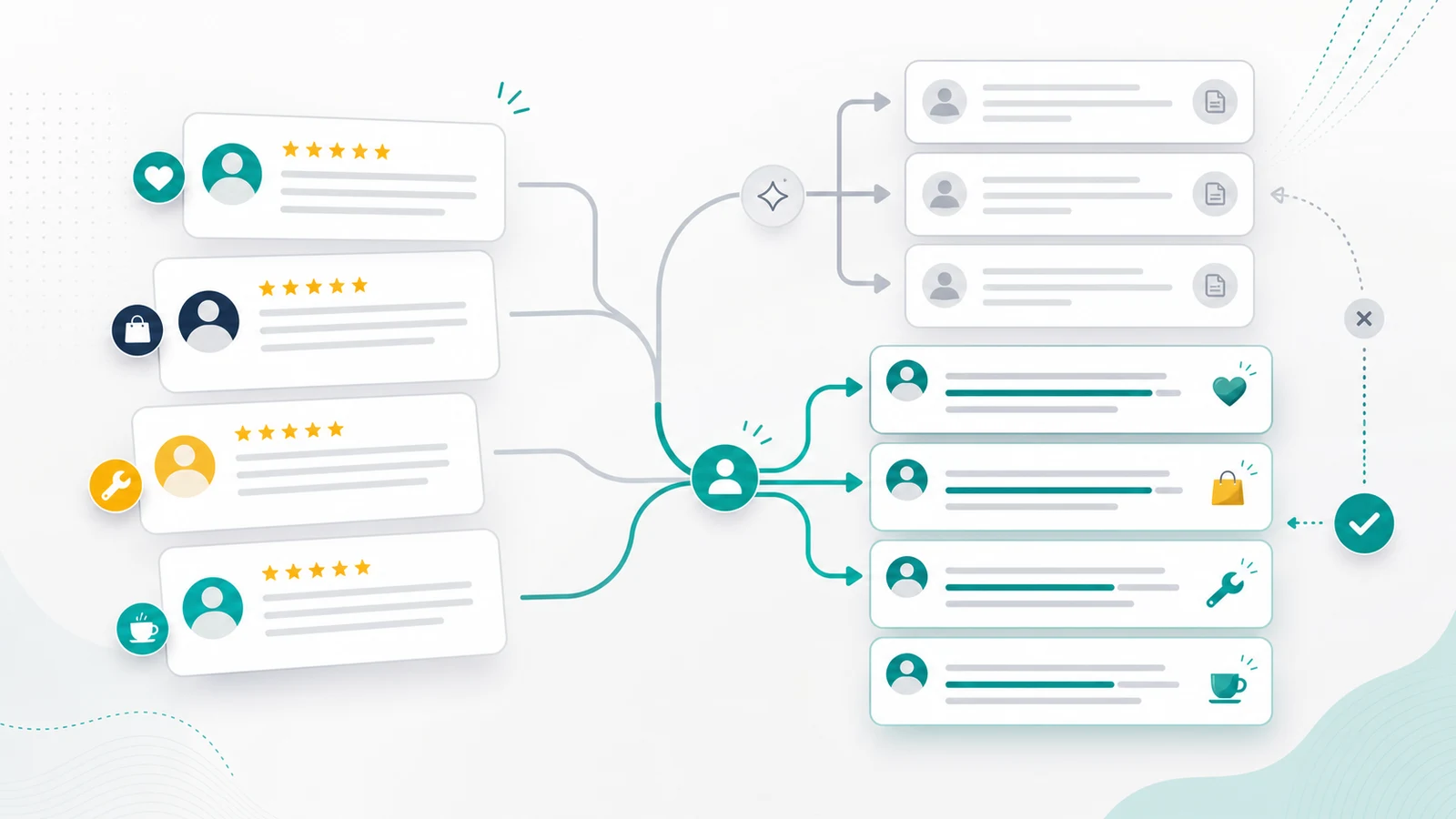
A response library is most useful when it sits inside a controlled process:
- Capture the review and location context.
- Select a response structure based on sentiment and topic.
- Add the specific detail from the review.
- Check accuracy, privacy, tone, and unsupported promises.
- Route sensitive or low-confidence replies to the right reviewer.
- Approve, revise, or reject the draft.
- Publish only after authorization.
StarReplies is designed around this distinction: drafting can be automated, but external action remains approval-gated. The goal is not to make every response identical. It is to help teams create a useful first draft, preserve their own voice, and keep a person responsible for what goes public.
The principle to remember
Use templates for consistency of judgment, not sameness of language. A good response proves that the business noticed what happened. One accurate detail and one relevant next step will usually do more than a paragraph of polished filler.
StarReplies is not affiliated with or endorsed by Google. Google, Google Maps, and Google Business Profile are trademarks of Google LLC.